Editor’s Note: The following article, penned by Darlene Kobobel, (founder of the Colorado Wolf and Wildlife Center in Divide), pertains to a decision by Colorado Parks and Wildlife (CPW) not to pursue any criminal action against a hunter who mistakenly shot a gray wolf that was part of the original group introduced in Colorado. Following a favorable verdict by Colorado voters regarding a state ballot issue, a certain number of wild wolves were reintroduced to the state in Dec. 2023. The shooting incident in question occurred in January 2026 and resulted in the hunter receiving a $140 citation and five license suspension points for taking a protected animal without proper licensing. To date, 14 of the 25 gray wolves relocated to Colorado by the state’s Parks and Wildlife agency have died. This total includes eight wolves from the initial Oregon group and six from the Canadian cohort released in 2025. Teller County, however, has not received any reports of injured or fatal wolves or possible livestock, resulting from the program. But Teller and adjacent areas have experienced occasional reports regarding the wild animals traveling through the area.
Colorado Wolf and Wildlife Founder Raises Concerns Over State Decision in Death of Gray Wolf
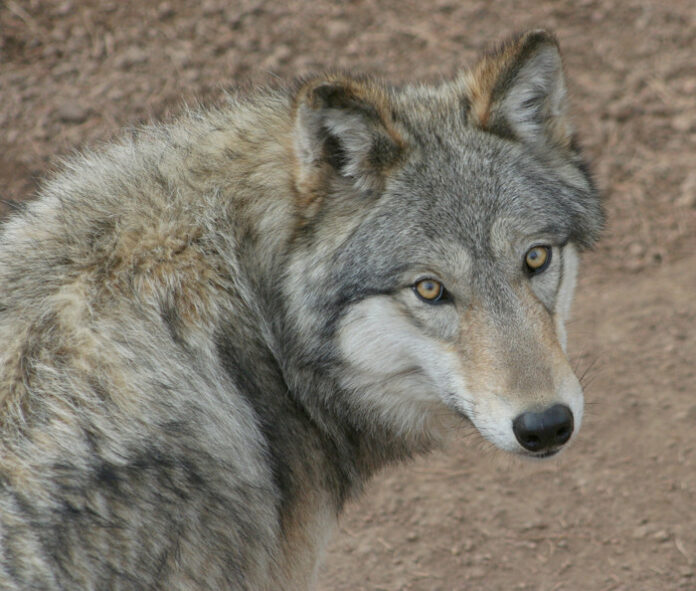
Darlene Kobobel, a member of Colorado’s Wolf Stakeholder Advisory Group (SAG), who also is the chief executive officer and creator of the Divide-based Colorado Wolf and Wildlife Center, is expressing serious concern over Colorado Parks and Wildlife’s (CPW) decision not to pursue additional penalties in the killing of female gray wolf 2504, an endangered animal protected under both state and federal law.
According to CPW’s investigation, wolf 2504 died after being shot by a licensed hunter who reportedly mistook the animal for a coyote. While the hunter voluntarily reported the incident and cooperated with investigators, Kobobel says the outcome raises troubling questions about the effectiveness of protections intended to safeguard Colorado’s reintroduced wolf population.
“The loss of any endangered wolf is significant,” said Kobobel. “When a protected animal can be killed due to mistaken identity with only limited consequences, it raises concerns about whether existing protections are strong enough to prevent similar incidents in the future, especially when the animal in question had a radio collar around her neck.”
Kobobel served on the Stakeholder Advisory Group, which spent months developing recommendations and helping shape Colorado’s Wolf Restoration and Management Plan. The group consisted of representatives with diverse and often opposing viewpoints, including conservation, agricultural, hunting, and wildlife interests. Despite disagreements on specific issues, stakeholders worked collaboratively to create a balanced framework aimed at ensuring the successful restoration and long-term coexistence of wolves in Colorado.
“The stakeholder process required countless hours of work and compromise,” Kobobel said. “It is discouraging to see the death of a protected wolf treated primarily as an unfortunate mistake when the success of the restoration effort depends on meaningful protection and enforcement.”
Kobobel argues that the incident highlights a broader issue regarding hunter responsibility and wildlife identification. Wildlife regulations have long been built on the principle that hunters must positively identify their target before taking a shot. If a person mistakenly harvests a species, they are not authorized to take, they can face penalties regardless of their intent.
“Responsible hunting requires certainty,” Kobobel said. “If someone cannot reliably distinguish a protected wolf from a coyote before pulling the trigger, that should prompt a serious discussion about accountability and the standards expected of licensed hunters.”
Another concern is the precedent the decision may establish. Critics fear that allowing the killing of a protected wolf to be explained primarily as mistaken identity could weaken deterrence and encourage future violations.
“What safeguards exist if ‘I thought it was a coyote’ becomes the default explanation whenever a wolf is unlawfully killed?” Kobobel asked. “The public deserves confidence that endangered species protections are being consistently enforced.”
This is a concern met with validity, as a well-known Facebook group established at the beginning of the wolf reintroduction “Colorado Wolf Tracker” has members sharing these sentiments to encourage the illegal killing of more endangered wolves.
Rob Smith wrote, “Take notes, folks. Remember “I thought it was a coyote, officer.” Bank that one. The info I looked up says the man won’t be charged, criminally, because it was an accident.” Another group member by the name of Shane Long posted “I bet we could get $1960 pretty easily to take care of the other 14!” William Crutchley commented “just a $150 tag. lol.”
Kobobel is strongly urging CPW to review and strengthen policies related to wolf identification, hunter education, and penalties associated with the unlawful killing of protected wolves. She believes stronger measures are necessary not only to reduce future incidents, but also to maintain public trust in Colorado’s wolf restoration program.
“The purpose of endangered species protections is to prevent avoidable losses and support population recovery,” she said. “Without meaningful accountability, many Coloradans will question whether those protections have real substance.”
As public attention on wolf restoration continues to grow, Kobobel expects the case to generate significant discussion among conservation organizations, hunters, agricultural communities, and concerned citizens throughout Colorado.
“The people of Colorado were promised that reintroduced wolves would be protected,” Kobobel said. “The long-term success of wolf recovery depends not only on management plans and public investment, but also on consistent enforcement when protected animals are unlawfully killed.”
*Darlene Kobobel served as a member of Colorado’s Wolf Stakeholder Advisory Group, which provided recommendations to support the implementation of wolf restoration and management efforts in Colorado. She advocates for responsible wildlife management, accountability, and the long-term success of wolf recovery initiatives. The Colorado Wolf and Wildlife Center started in 1993 when founder Darlene Kobobel rescued a wolf hybrid named Chinook. It originally opened as the Wolf Hybrid Rescue Center before being officially transformed and renamed into the Colorado Wolf and Wildlife Center in 2003.