
CPW: Packs Currently Hiding Out in Dens
Trevor Phipps
The wolf invasion that struck Teller County for two consecutive months earlier this year has come to a halt, at least for now.
The latest wolf activity map released by Colorado Parks and Wildlife (CPW) shows that the wild wolves drifted far away from the county (and all of Southern Colorado).
This development could come as a relief for local ranchers, cattle owners and rural property owners, who were closely monitoring the wild animals’ pathway throughout Colorado. Although not directly impacted, Teller prevailed as the next probable location for the wolves. The county commissioners had received a slew of comments regarding the situation.
During February and March, at least one wolf traversed their way into the Ute Pass region and other parts of Southern Colorado. Their activity now, though, shows them mostly keeping to areas in the northwestern part of the state.
The wolves that once travelled close to the cities in the Front Range weren’t tracked west of Fairplay between March 24 and April 21. According to CPW officials, the wolves that entered Teller County in February and March were believed to be lone females that were traversing hundreds of miles a day in search of a mate. Now, their movement has drastically changed.
Officials say that the limited wolf activity is a sign that the wolves have fled to their dens. The denning season for wolves typically starts in mid-March. The peak of the denning season (where the least amount of activity is seen) usually occurs between April and May. So far, CPW has not announced the formation of any new packs.
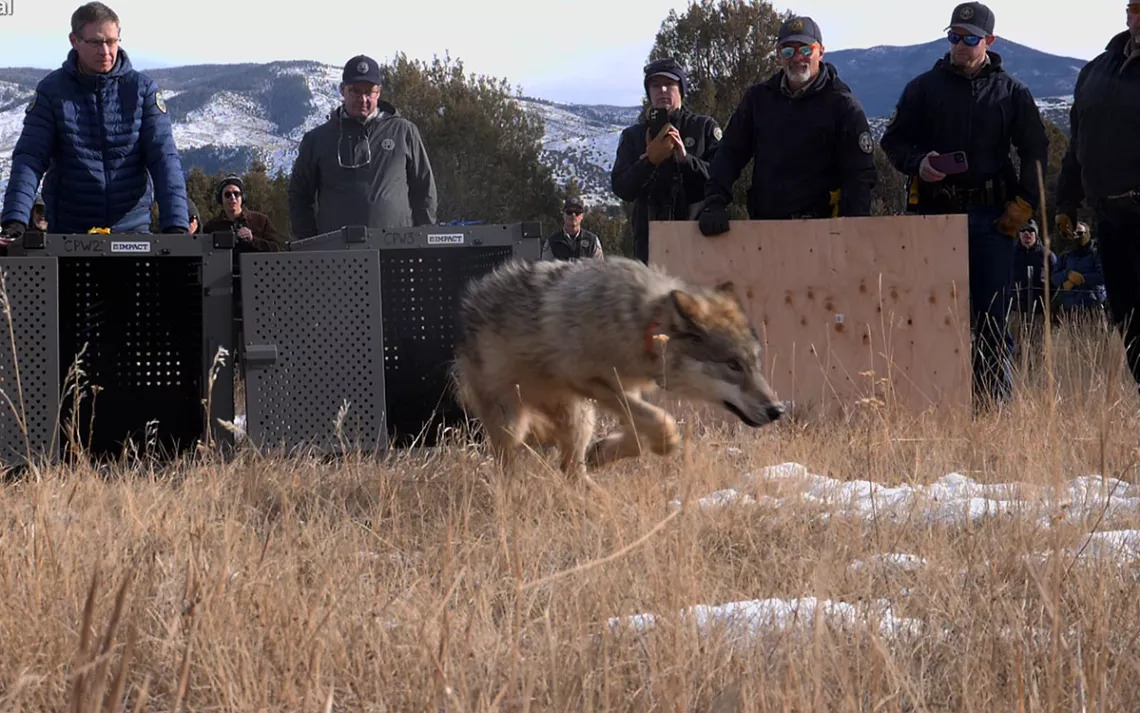
The state currently has four confirmed wild wolf packs since the voter-approved wolf reintroduction in late 2023. The packs CPW continues to track include: the Three Creeks Pack in Rio Blanco County, the One Ear Pack in Jackson County, the Copper Creek Pack in Pitkin County and the King Mountain Pack in Routt County.
However, even though the King Mountain pack is still on the list, both breeding couples died earlier this year. The two deceased wolves had four pups, one of which is collared. CPW officials are unsure whether the pack will stay together or break apart.
Wolf Fatalities Continue
Overall, 2026 has been a rough one for Colorado’s wolf population. Three wolves had already died this year by mid-March.
The first wolf fatality occurred on Jan. 16 in northwestern Colorado. Officials say they received a mortality signal on a collar that belonged to female wolf 2504 that was relocated from British Columbia, Canada. The death is still being investigated.
A four-year-old male wolf (2305 from Oregon) then died later that month on Jan. 28. Reports indicate that the patriarch of the King Mountain pack suffered complications that occurred during a routine collaring/battery swap operation that included the pack’s matriarch and one pup. The female and the pup were not harmed during the incident.
However, tragedy for Colorado wolves struck again when the same pack’s matriarch died on March 11. An investigation is still being conducted for the wolf that died just six weeks after the pack’s patriarch.
The March death marks the 13th wolf fatality out of the 25 relocated to Colorado from other areas since 2023. Six of the 10 wolves that were captured from Oregon and were released into Grand and Summit Counties in December 2023 have died. Further, seven of the 15 wolves that were captured from British Columbia and relocated to Pitkin and Eagle Counties in January 2025 are also deceased.
Unfortunately, the wolves that are still inside state boundaries have continued to be responsible for livestock depredations. CPW reported that one of the relocated wolves was responsible for the death of a calf on April 23.
The incident marks the fourth recorded livestock casualty caused by wolves in 2026, including a Jan. 24 incident in Rio Blanco County (northwestern Colorado) where 11 sheep were killed. On Feb. 7, a dog was killed in Jackson County in the far north part of the state.
Colorado Looks at Cutting Funding for Wolves
As a result, wolves have become the next group under the chopping block as Colorado lawmakers look to reduce the state’s budget deficit. Last month, the Joint Budget Committee reviewed three bills sent to them by lawmakers that would cut wolf funding. Only one out of the three bills passed.
On April 23, the Joint Committee voted to move forward with an amendment made by the state House that would ask CPW to not spend any more money out of the state’s general fund for the relocation of more wolves. CPW receives $2.1 million every year to run the wolf reintroduction program. This won’t change, but they now have further directions regarding how the money should be spent.
Under the amendment proposed by lawmakers, CPW could still use grants, donations and gifts to pay for new wolves to be reintroduced. The committee did edit the amendment to allow CPW to also use non-license revenue from its wildlife cash fund on new wolves.
So far though, the state has not been able to find a location to obtain future wolves. The relocation planned for earlier this year was suspended.