

GMF Trustees May Adopt More Stringent Safety Regulations
Rick Langenberg
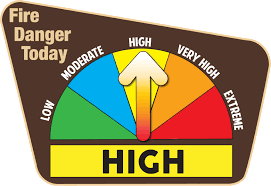
Despite a brief recent break from dry weather, fire risks in the lower Ute Pass area continue to escalate, making it one of the most wildfire-prone regions in the state and possibly the entire West.
Fire maps have the entire region, covered in shining, red-danger colors, as community leaders now mull the best way to survive a potential fire disaster this summer and fall. In fact, the common call to arms is a simple statement: “It is not a matter of if, it is a matter of when.”
Officials are praying for rain and concede that if a major fire occurs, the area doesn’t have the mitigation capabilities to survive.
“The whole town is at risk,” said Green Mountain Falls Mayor Todd Dixon, during a recent public hearing on new proposed fire safety rules, mandated by the state. “We are in the highest (level) of regulations.”
This dilemma has prompted town leaders to consider adopting the new Colorado Wildfire Resiliency Code, a decision set for this evening’s (May 5) regular meeting at the GMF Town Hall. However, much is at stake with the trustees’ ultimate decision. Consequently, the session is likely to generate considerable discussion.
This complicated code action could escalate the cost of building in GMF, and for residents doing substantial additions and roof modifications. In addition, it would have impacts for the town government, which may have to establish a system for inspections for new projects that will have to abide by new fire protection codes.
And then there is the touchy question of home insurance: Will costs go up for residents and property owners, with the price of new construction rising with the adoption of the state rules.
If the town does not approve the codes, will GMF lose eligibility for state wildfire mitigation grants—the same grants on which the town depends heavily on? Additionally, will insurance companies decline coverage for local properties due to the town’s refusal to abide by these new rules?
“It’s a mess,” admitted Dixon. The mayor doesn’t have a problem with the end goal of the new state fire resiliency rules, which he believes is consistent with recommendations made by its local Wildfire Mitigation Committee. But the mayor, as he has regarding many state proposals, objects to having unfunded mandates.
“It is a state mandated code,” said Dixon. “I wish they would have just come up with a set of guidelines, instead.” But that said, he admitted the town could risk losing substantial grants if it doesn’t step on board. He noted that a few other fire risk communities in the region, such as Manitou Springs and Monument, have approved the state codes for this reason.
But even if the town approves the state wildfire resiliency regulations, he noted that officials may have to bypass hiring inspectors due to the costs involved, and instead, rely on an affidavit system for those doing local construction projects.
During an earlier public hearing in late April, public comment was mixed regarding the state code proposal, with some residents raising questions about certain rules and specific impacts. Representatives of the wildfire mitigation committee, though, appeared supportive of the changes, saying that the state code is in line with what their group has proposed.
Trustee Brandy Morales indicated the rules are a necessary reality to accept, in lieu of the town’s considerable fire risk.
Who Will Get Impacted by the New Fire Rules
More specifically, the new code will affect all new residential and commercial construction projects, which must abide by the new more stringent fire rules, along with home additions of 500 or more square feet, and exterior modifications of 25 percent or more of walls or roof surfaces.
Most current older homes, already built, would be exempt from the new rules, as long as they are not classified as a safety hazard. At the recent public hearing, Dixon indicated these properties would be grandfather-in from the proposed requirements.
But if the current drought continues, this list of problem properties in GMF could increase. GMF has already launched an effort to crack down on nuisance trees through a complaint-driven enforcement policy.
The new state rules are designed to establish defensible space requirements, fire-resident building materials, home hardening standards and emergency access rules. Dixon doesn’t have a problem with the state’s overall goals with the adoption of these codes, but he doesn’t like the “do this or else” attitude. For example, the fines for not abiding by the state’s mandated fire safety rules could exceed $2,500 per offense.
Tonight (May 5) the trustees will discuss this pressing issue, which may lead to a lively meeting. Fire mitigation is an issue that ignites lively comments in GMF.
Some community members complain that town officials aren’t doing enough in enforcing mitigation guidelines, such as cracking down on problem trees, while others raise concerns about property rights. Plus, Dixon concedes that the issue is further complicated by the fact that some say, ‘I want to live in the forest.’
A Plea for More Local Mitigation
Besides the state rules, town leaders are trying to get more individual property owners to do mitigation projects, such as clearing their land of flammable material and trimming vegetation and cutting down dead trees. Local residents can obtain free property inspections by contacting the local Wildfire Mitigation Committee at fmac@gmfco.us.
Dixon said the town, when addressing property owners with problem trees, is willing to work with them to develop an overall action plan over a several-year period. “It can get pretty expensive,” admitted the mayor.
He said town officials don’t want to take an over-regulatory stance.
But if the drought and fire danger crisis continues, this stance may have to change.
In addition, time is not on the side of GMF in seeking a fire safe community. The mayor says that with their current mitigation efforts, the town still may just be able handle the impacts to combat or protect the area from smaller fires.
“If we get hit with a major fire, I won’t be here. I will be evacuated and watching it on TV,” quipped the mayor.
As noted by another trustee member, the current mitigation and emergency preparedness efforts could simply give the town an opportunity “to buy some time” when a fire disaster strikes. A few minutes, though, could mean the difference between life and death, when a Colorado wildfire strikes.