

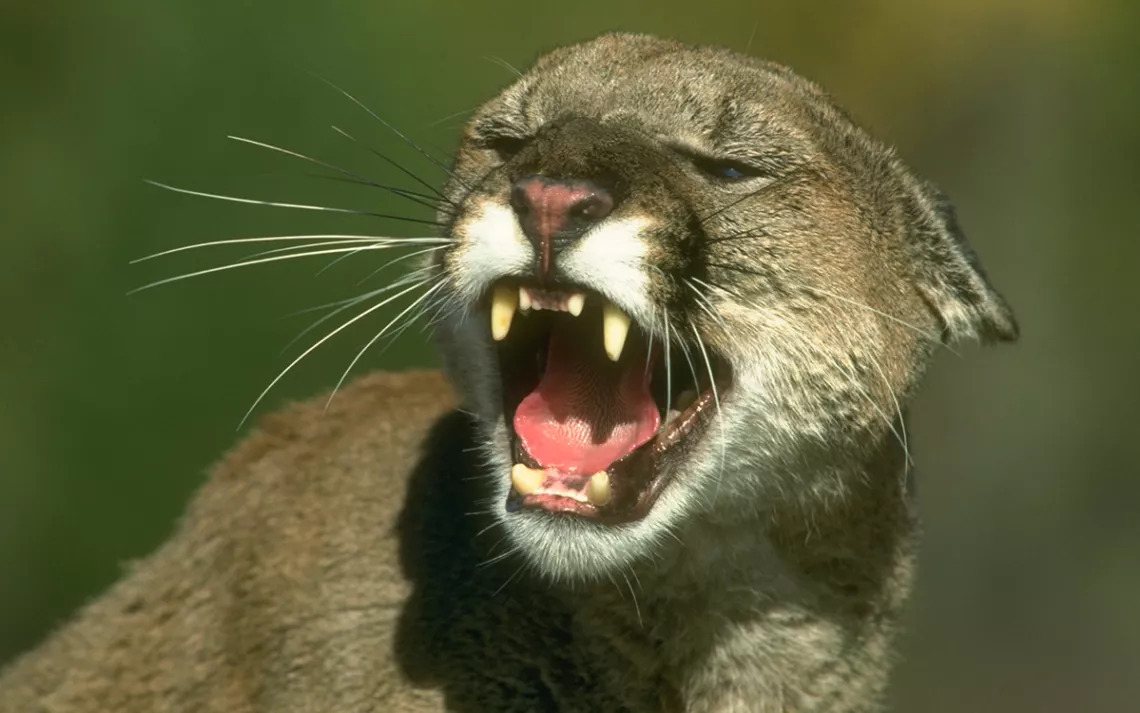
CPW Offers Tips to Avoid Brutal Cougar Encounters
Trevor Phipps
One day an outdoor recreationist in Colorado can be walking through the woods when they suddenly hear something nearby.
After they search the area, they lock onto two eyes staring at them. Now, they realize they are going toe to toe with a wild cat.
Although rare, similar instances like this are increasing, especially after recent mountain lion encounters in an area of northern Colorado. On New Year’s Day, a group of hikers were walking along the Crosier Mountain trail (located near the town of Glen Haven just east of Estes Park) when they saw a mountain lion (or cougar) laying over a person lying down in the middle of the trail.
The fatal mountain lion assault hit home for many local residents, area hikers and pet owners, especially in the Ute Pass, where lion sightings are not uncommon this time of year. Although no human causalities have occurred in our area, a number of canines and cats have often been killed locally by rogue cougars over the last few decades, with warning signs frequently dotting the landscape, and at entrances to some popular trail areas. Young students at Ute Pass Elementary were once regularly escorted by law enforcement officials when heading to school due to lion sightings in the early morning.
These wild animals, regarded as great hunters, are elusive and as CPW officials often say, “You probably will never see a mountain lion, but they will see you.”
In fact, an actual killing of a hiker by a mountain lion, such as what happened in northern Colorado, is rare.
The recent fatality marked an occurrence that hasn’t taken place in Colorado for over two decades. Since 1990, this recent cougar attack marks the 29th in the state since 1990. The New Year’s Day death only marked the fourth fatality caused by mountain lions in the last 35 years.
The last recorded mountain lion death occurred on October 2, 1999. That day, three-year-old Jaryd Atadero went missing during a hike with a religious group. The boy’s remains were eventually found four years later with evidence of a cougar attack.
But according to reports that came out after the recent attack, the incident doesn’t seem to be isolated. In fact, once the fatality occurred, several other residents in the Glen Haven area reported encounters with a group of mountain lions that many believe are the ones responsible for the recent death.
Two hikers from northern Colorado told CBS News Colorado about an incident where they were hiking the same trail and suddenly got surrounded by three or four mountain lions. A few days later a Glen Haven resident caught a group of four mountain lions on an outdoor camera on their property.
Trail runner Gary Messina told news stations that he had to fight off a mountain lion with a branch during a confrontation that lasted several minutes on the Crosier Mountain Trail in November. Glen Haven resident Mary Crone said she was out walking her dog last October when a cougar killed her pet.
Colorado Parks and Wildlife (CPW) officials have since euthanized two mountain lions in the region and they are testing them to see if they were involved in the fatal attack. CPW officers were also searching for a third mountain lion that could have also been involved in the recent incidents.
How to Avoid a Deadly Mountain Lion Encounter
Although mountain lion sightings are considered to be very rare, they still do occur locally in the Pikes Peak region. And even though the recent attacks were over 100 miles away from Teller County, the entire Ute Pass region is still labeled as “Mountain Lion Country.” At various times in the last few decades, stern warnings have been issues, and residents have been advised to not let their pets roam freely without a leash in the outdoors, outside of their yard.
According to the CPW website, the mountain lion population in the state runs between 3,800 and 4,400 not counting kittens. “In Colorado, lions are found in areas of piñon pine, juniper, mountain mahogany, ponderosa pine, and oak brush,” the CPW website states. “Lions generally are most abundant in areas with plentiful deer. Male lions mark their home range boundaries with scrapes – piles of dirt and twigs – to communicate occupancy to other lions. If you see these telltale scrapes, avoid the area and make family and nearby neighbors aware of potential lions in the area.”
CPW advises that it is never a good idea to do anything that attracts deer onto a property. This includes keeping pet food indoors or keeping bowls clean if left outside. The officials say to always keep pets on a leash and avoid outdoor activity at dusk and dawn. It is also wise to eliminate hiding places like bushes and tall grassy areas.
While hiking in the outdoors, it is always smart to travel in groups and make lots of noise. When hiking with children or pets, officials say to keep them close.
What to Do During a Mountain Lion Encounter
If a person does come into contact with a mountain lion, never approach it especially if it has kittens nearby. They say to move back slowly with hands high in the air trying to look big. Make loud noises and try throwing rocks at the lion to scare it away. However, mountain lions could start to attack when a victim bends down to pick up a rock.
They say to never run away because it could spark the animals natural attack mode. If an animal does attack, officials say it is a good idea to fight back as hard as possible. Since mountain lions are used to feeding on prey like deer, they often get scared when whatever they are attacking fights back.