Dry Conditions to Continue with Little Signs of Relief
Trevor Phipps
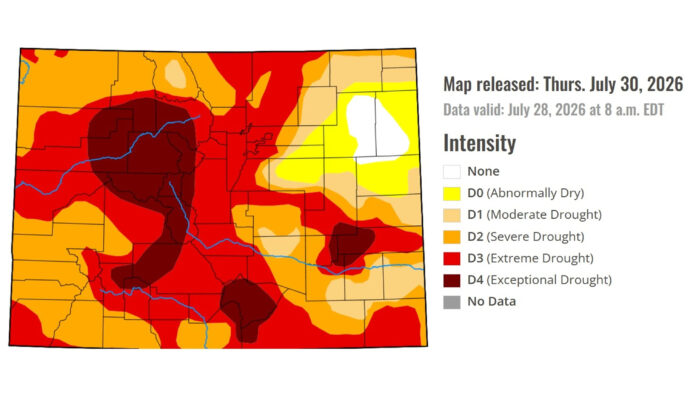
Colorado residents and local leaders are starting to perfect their rain dances in the hopes of offering reprieve from brutal, near-record drought conditions.
However, their efforts have failed to produce much moisture, leaving the state in a dire condition.
As fires continue to torch the state, low moisture levels have created other problems as well. Earlier this month, the Teller County commissioners held an emergency meeting to address the issue of rural communities running low on water and wells getting depleted of all available H2O. They pleaded for temporary, emergency help from the state.
Water levels are extremely low in Florissant and especially the Arabian Acres subdivision. For now, water from Divide and other areas has been used to help, but the problem persists.
In addition, it was recently announced that the public water filling station in Florissant would be closed for public use until further notice. With low water levels, the water that the county does have is being used by residents.
Travelers can still fill up water tanks in Divide for the time being. But if the drought conditions persist, the water station in Divide might also be closed to the public.
For the past few weeks, many hoped that the region’s annual monsoon season would bring much needed rain to the area. However, while there have been some storms that produced rainfall, the total amounts haven’t been anything to brag about.
And the local weather forecasts don’t show much promise. In the short term, meteorologists are calling for the same weather pattern that locals have experienced for the last month.
Most forecasts do show a little more chance for rainy days and thunderstorms mixed in with hot and dry days. The bad news is that during the days when there is a chance of rain, the amounts aren’t expected to be very high.
Some forecasts show a chance of small amounts of rain throughout August. However, other forecast models show a lot of hot and dry days mixed in with chances of rain.
The Farmer’s Almanac does call for cooler temperatures and about an inch more precipitation than normal for southern Colorado during the month of August. But then in September, the Almanac calls for above average temperatures and lower rainfall amounts.
El Nino Making a Grand Return
The entire state of Colorado should probably brace for dry conditions to last through the fall. The only good news is that the El Nino patterns are brewing in the Pacific Ocean.
During El Nino years, weather patterns shift giving more moisture to the southern states and less to the northern states. Since Colorado is stuck in the middle, meteorologists expect higher snowfall in the southern part of the state than in northern Colorado.
“In its July 9 update, NOAA’s Climate Prediction Center said El Niño is expected to strengthen through the end of 2026,” an article published by UnofficialNetwroks.com stated. “Forecasters now give El Niño a 97% chance of continuing through early spring 2027 and an 81% chance of reaching ‘very strong’ intensity between October and December 2026. If that forecast holds firm, the event could rank among the largest El Niños observed since modern records began in 1950.”
The article continued to state that southern Colorado and the San Juans have the potential to receive above average snowfall amounts. Meanwhile, the Northern Rockies will probably see less moisture than average.
Major Wildfires Continue to Cause Devastation Statewide
At press time, there were still eight major wildfires burning across Colorado. The biggest fire is the Aspen Acres blaze burning southwest of Pueblo. According to a recent report, the fire had grown to more than 100,546 acres and crews had reached a 61 percent containment.
The increase in containment has helped authorities release some of the mandatory evacuations. However, some people in Custer County who had returned home were forced to evacuate again last week.
Authorities have confirmed that the Aspen Acres fire was human caused, but it is still under investigation. Recently, a power company was sued over the fire by residents saying that the company should have cleared trees and organic material that helped fuel the blaze.
So far, Teller County has avoided the wrath of these major fires. Most of the wildfires in Colorado this season have torched areas on the state’s western slope and in northern Colorado.
Besides the Aspen Acres Fire, the next closest blaze burning is the Willow Fire. The Willow Fire started in Lake County just west of Leadville on June 28.
As of last week, the Willow Fire was 7,181 acres and only 41 percent contained. Officials reported that at least 12 people have been injured in the fire. Authorities said they have evidence that the fire was human caused, but they have no suspects at this time.
Teller County is still facing a Stage 2 fire ban while the dry conditions persist.