

CPW: Mule Deer Numbers on the Decline in Teller County
Trevor Phipps
As a part of their duties to manage the state’s wildlife, the Colorado Division of Parks and Wildlife (CPW) agency conducts annual counts of certain species across the state.
The majority of the counts take place using aircraft as wildlife officials count bighorn sheep and mule deer to estimate population numbers. Officials use planes and helicopters to fly over the state’s open lands to track down animals and take their counts. Every year, CPW counts the number of bighorn sheep in the Pikes Peak mountain range.
But doing these counts in Teller County, and other rural areas, poses major obstacles. That is a reality I learned first-hand in partaking in a detailed and grueling deer count in the Teller mountains.
Mule deer counts take place annually by using aircraft to scan open lands across El Paso, Park and Teller Counties. However, due to a recent surge of people moving into more rural areas, a different counting method had to ensue.
According to Ty Woodward, CPW’s area biologist, counting mule deer inside subdivisions proves to be a difficult task. Deer can hide in neighborhoods in places where they can’t be seen by aircraft. In addition, CPW authorities try to limit impacts on citizens with the flying of low helicopters directly above their houses.
Therefore, for the last several years, CPW has conducted manual counts of mule deer populations inside many of the dozens of subdivisions scattered across Teller County. And in fact, the manual deer counting process involves quite an operation, a process I discovered really quick.
On Jan. 15, volunteers and wildlife officers from across the state joined Woodward and local wildlife officials in conducting mule deer counts in subdivisions located in Teller County, west of Woodland Park. The operation included 30 CPW staff and volunteers that split up in small groups to cover all of the rural subdivisions.
The groups first met at 6:30 a.m. to conduct a manually count of all of the mule deer residing in Teller neighborhoods. The groups took a break for lunch and then reconvened at 1:30 p.m. to conduct a second count in the afternoon. The second count took place until sunset.
In groups of two, the volunteers and staff split up in vehicles to drive around every road in every subdivision on the list. The vehicles drove down the mountain roads inside the subdivisions slowly, while the experts peered out of windows on each side of the CPW trucks.
As soon as a deer was spotted grazing on someone’s ranch property or relaxing under a shady tree, the teams stopped to further inspect. The wildlife experts used binoculars to confirm the deer sightings and get a solid count on how many were in the group.
While they were examining the deer with their binoculars, the wildlife officers were looking for signs to tell the deer’s age and sex. While age is tough to decipher with the blind, uneducated eye, the officers used things like the color and fuzziness of their fur and facial structure to tell if the deer seen were fawns (baby deer), does (female adult deer), or bucks (adult male deer).
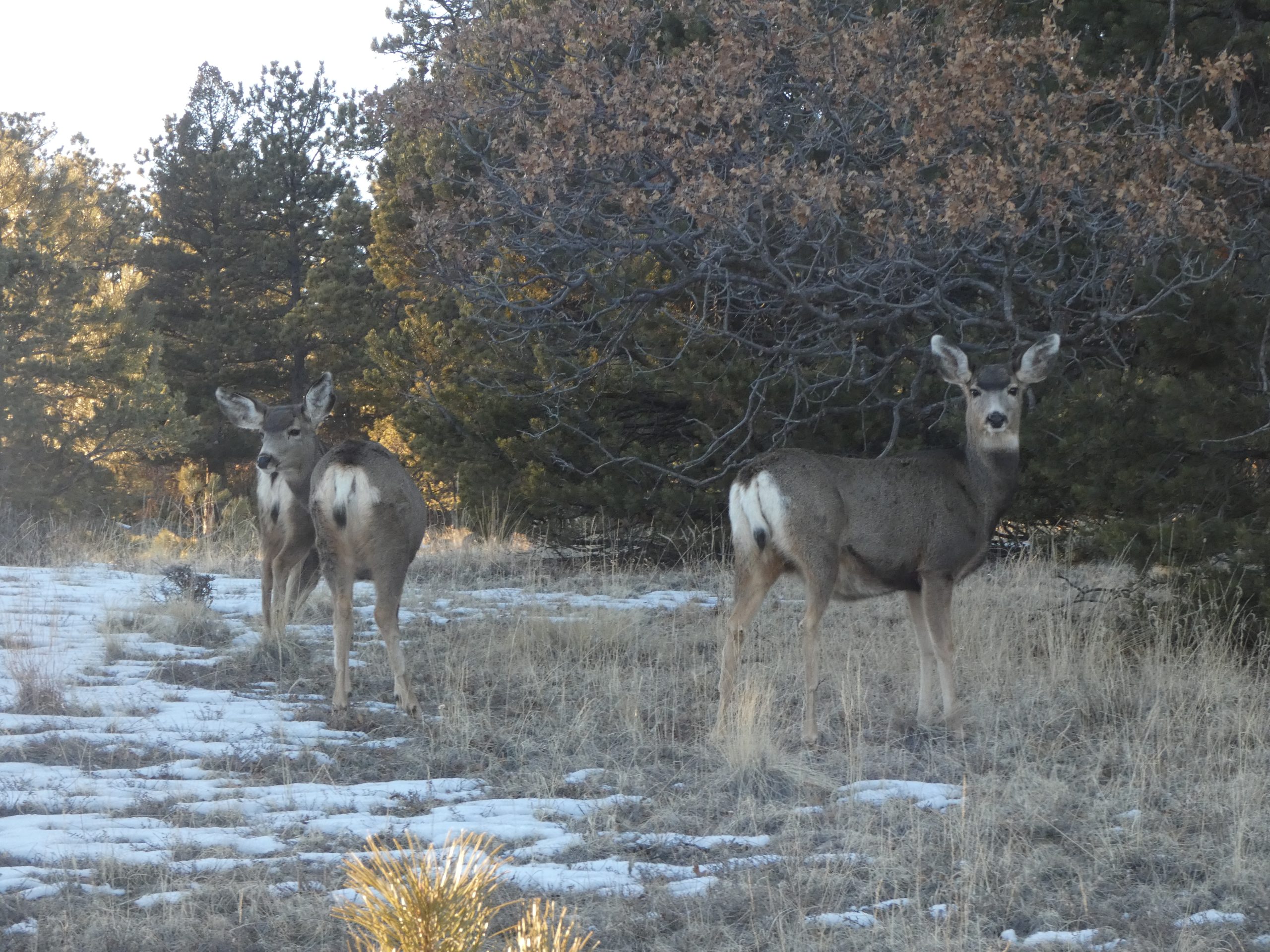
At the end of the day, the evening count tended to be more fruitful than the morning count. Around 300 deer were counted in the subdivisions in the morning, while 400 were counted in the afternoon. But still, the biologist said that counts have been lower than they were in the past.
Why Does CPW Count Deer Populations?
As a part of the deer counts, CPW officials also keep track of the fawn-to-doe ratio and the doe-to-buck ratio. CPW then keeps records each year so that they can analyze trends that can tell them if the deer population is healthy or not.
“It is the job of a wildlife agency to manage wildlife for the benefit and enjoyment of people,” Woodward said. “But also, to encourage healthy ecosystems and healthy populations.”
In order to maintain the health of certain types of animals, the agency counts the population to see how many deer they are dealing with. Another reason the agency keeps track of animal population is for hunting.
For example, if a population of an animal is too high than what is healthy for the ecosystem, as outlined by CPW’s herd management plan, the agency can issue more tags for that species to reduce the population. If a population is too low, CPW can reduce the number of hunting tags. Further, they can bring animals in from other places to grow populations, which they have done in Colorado with elk and bighorn sheep.
The subdivision counts specifically take place so that CPW can get an idea of how the increase of people moving to rural areas has impacted the wildlife populations. Forty-six subdivisions across Teller County are included in the counts. However, larger communities, such as Woodland Park and the west side of Colorado Springs, are not counted since policies regulating wildlife fall on the individual municipalities.
According to Woodward, this year could be the last time that the manual subdivision counts occur. This year they are going to re-evaluate to determine if the information they receive is worth the effort. Moreover, they will also determine if there are enough deer residing inside subdivisions to constitute a separate count.