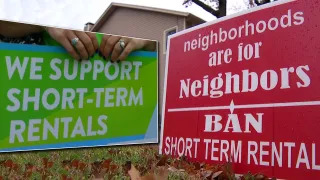
Commissioners Still Holding Work Sessions Regarding STR Regulations
Trevor Phipps
The controversy surrounding the handling of short-term rental (STRs) properties – an issue that continues to command center stage attention throughout the state – has now invaded the unincorporated sections of Teller County.
As the Teller commissioners take their time to decide whether to officially allow or ban STRs, or permit them with certain guidelines, verbal sparks are definitely igniting.
At a recent commissioners’ meeting, one resident spoke out against certain regulations proposed during a work session before anything becomes official. The county commissioners fired back and reminded citizens that the Teller government is still working on coming up with a detailed STR ordinance.
One fact remains certain: Teller elected leaders won’t win any speed records for finalizing STR rules and overall policies.
For the past two years, county officials have been debating what type of regulations should be placed on STRs operating inside unincorporated parts of the county. Currently, county land use regulations do not allow properties to be used as short-term rentals.
However, despite technically not being legal, many STRs have slipped through the cracks and are operating. After the issue sparked much controversy in Woodland Park and other communities across the state, Teller County officials launched a long, drawn-out process to get information surrounding the community impacts of STRs.
Since STRs are not allowed under the county land use regulations, officials have been grappling with what types of rules should be placed on those types of businesses. At the very least, the county commissioners need to change the law to license and regulate STRs, so that they are no longer illegal.
Over the past few years, the STR debate has rattled every city within the county as well as other communities across the country. In Woodland Park, citizens successfully passed a ballot initiative to ban non-owner occupied STRs. This occurred after the city council proposed an ordinance that would permit STRs in residential neighborhoods, but with a cap.
During that time, county leaders sat back and let the dust settle to see what municipalities within the county were choosing to do about STR regulations. But then in 2025, the commissioners held public town hall meetings in various places across the county to get feedback from residents.
The county commissioners then held a series of work sessions to hear from experts about different impacts STR business have on the community. In the end, the commissioners said that the county seems to be split 50/50 between those who think STRs should be allowed and those who wish they were banned.
Negative Effects Outlined with New Proposed Regulations
The resident who spoke at a recent county commissioners’ meeting argued that some of the new rules proposed could negatively affect his family’s livelihood. He told the commissioners that he and his wife spend their time working on two separate STR properties they own.
He also opposed a proposed rule limiting STRs to only one per property. Further, he questioned possible regulations not allowing accessory dwelling units (ADUs) to be used as STR properties. Pro-STR advocates say these rules could impact local businesses local in the county.
As a solution, the resident suggested that the Teller commission issue licenses and then take some time to see what regulations should be put into place. “I had previously recommended to the county to go slow,” the resident said. “Start off with just getting all of the STRs registered, find out where they are, then start gathering data and make data-driven decisions. Ordinance 23 from what I see so far does not go slow. There is no time period for gathering data about existing STRs, their locations, their issues and their benefits. This no data approach will cause damage.
However, County Commissioner Dan Williams disagreed. “Eighteen to twenty months of work as a military guy in my view is going pretty slow, pretty deliberate and (doing) lots of listening,” Williams said. “Six regional engagements 700 surveys, and we have had several people at our work sessions. We are about to start a Quasi-Judicial process, and we have heard you and a lot of folks. For the record today, STRs are illegal in Teller County. Our possibilities go from prohibition completely to doing nothing.”
Williams said that he disagreed with the fact that their decisions aren’t being “data-driven.” He noted the commissioners have talked with many industry experts and they know through website listing and assessor information where most of the current STRs are located.
Williams said that the commissioners’ final STR decision will be based on the life, health and safety of county residents.
“For an example, an abused septic system 200 feet away from a well can poison one of these kids (referring to the Teller County Fair crowd present at the meeting) with nitrates and we have had that happen before,” Williams said.
The resident though, disagreed with Williams’ STR analysis. “First off, when I started my STR I called the county and the person I talked to said, ‘there are no regulations do what you want,” the resident said. “I did not purposely do anything illegal.”
No date has been set for when the commissioners’ may formerly introduce their STR ordinance, which will have big impacts in unincorporated sections of the county.